Dr. Lauren Gutterman Discusses the New Podcast, "Sexing History."

UT American Studies professor Dr. Lauren Gutterman, along with Gillian Frank (fellow at Princeton University's Center for the Study of Religion), have started a new podcast called Sexing History, "a podcast about how the history of sexuality shapes our present." We asked Dr. Gutterman and Dr. Frank about their inspiration for the project, the first few episodes of the podcast, the relationship of podcast to pedagogy, and the direction they hope to take the podcast in the future. You can find the podcast at: www.sexinghistory.org. Please read on!
Can you tell us a little bit about the podcast and how you arrived at the project?
GF: Sexing History explores how the history of sexuality shapes present day sexual politics, values, communities and identities. Lauren and I are the co-hosts. Our producers are historians Rebecca Davis, Devin McGeehan Muchmore and Saniya Lee Ghanoui. We’ve all worked together in various capacities for years and all share a commitment to telling accessible stories about sexual diversity in the American past. We were able to launch Sexing History through the generosity of Allen Zwickler of the Phil Zwickler Charitable and Memorial Foundation.LG: Gill really deserves credit for coming up with the idea for a podcast on the history of sexuality. He approached me about it this summer and brought our amazing team of producers together. While I’ve worked on digital history projects including OutHistory.org a Wikimedia website on LGBTQ American history, and more recently Notches: (Re)marks on the History of Sexuality an international history of sexuality blog, I was excited about the possibility of engaging the broader public through audio recording rather than text.
How do you see podcasting as different from more traditional academic publishing? Why did you choose to work in this medium?
GF and LG: Writing for a podcast is quite different from writing for an academic journal. To begin with, the timeline is much faster. Over the summer and fall we’ve been able to write our first three episodes, whereas an academic journal article typically takes years to publish.Writing for an audience of listeners, rather than readers, also comes with particular challenges and opportunities. With episodes of just twenty-to-thirty minutes, we need to get to the heart of a topic quickly and we have to leave out details that aren’t essential to the story we’re telling. We try to write shorter, more readable sentences, cut out academic jargon, and strike a more conversational, colloquial tone than we would in our other work. The podcast also allows us to highlight audio from the historical events we’re discussing as well as the voices of leading scholars and historical figures, which, of course, we can’t do on paper.We chose to work in this medium because we suspected and hoped that people who might not have the time or inclination to read an article about the history of sexuality would find listening to a podcast more accessible and engaging.
Your first three episodes discuss the history of sexuality in relation to high school proms, abortion, and "breast developers." How did you choose these topics? What bearing do these issues have on present-day American society?
GF and LG: We discuss potential topics together with our producers Devin McGeehan Muchmore and Saniya Lee Ghanoui and then do some initial research to see if relevant audio is available. As our first few episodes suggest, we are thinking about the history of sexuality in a broad sense, including LGBTQ history, reproductive politics, standards of beauty and desirability, and more. We’re currently writing future episodes on cultural battles over interfaith marriage in the 1970s, and evangelical sex advice.One of our major goals with Sexing History is to provide listeners with an historical context for contemporary events, and each of our episodes speaks to the present in some way. Our second episode, for example, examines the 1975 case of Dr. Kenneth Edelin, an African American physician who was convicted of manslaughter in Massachusetts for performing a legal second trimester abortion. His trial transformed the anti-abortion movement, which, following his trial, began to focus on limiting access to abortion rather than overturning Roe v. Wade. In a sad coincidence, just this month, the House of Representatives voted to pass H.R. 36, legislation that would make abortions after 20 weeks of pregnancy a criminal offense, and would impose fines or prison terms for abortion providers who violate it. The similarities between the case of Dr. Kenneth Edelin’s case in the 1970s and the discourse of today is striking.
What projects or people have inspired your work more broadly?
GF and LG: Both of us are avid podcast listeners. Some of our favorites include 99% Invisible, Criminal, and The Moth, Radiolab, and You Must Remember This. We’re influenced and inspired by the ways these podcasts approach storytelling, unpack complex issues, and find ways to link American history to contemporary culture.
How do you see your work fitting in with conversations in academia and beyond?
GF and LG: Sexing History allows us to both highlight existing scholarly work on the history of sexuality and to push academic conversations forward. For our first episode on gay proms, we interviewed professor Amanda Littauer who is researching the history of queer youth activism in the United States. Several scholars have written about the case of Dr. Kenneth Edelin, and in our second episode we were able to interview professors Johanna Schoen and Mary Ziegler, about the case and the anti-abortion movement after Roe v. Wade more broadly. Our third episode about the Mark Eden corporation, which fraudulently marketed a piece of exercise equipment as a “breast-developer” for more than a decade in the nation’s leading women’s magazines, has not itself been the subject of scholarly examination, but professors Elizabeth Matelski and Natalia Mehlman Petrzela who write about post-war female beauty standards and fitness culture, respectively, helped us to contextualize this particular manufacturer’s history.
How do you think your podcast has affected your teaching? Or, conversely, how do you think your teaching has affected the podcast?LG:
In class and on the podcast I try to make the past more accessible and more relevant to students and listeners. Often in class, I’ll invite students to examine a particular object or text, like a political cartoon or a magazine advertisement, in light of broader themes we’ve been discussing. In some ways Sexing History takes a similar approach. By looking in-depth at Aaron Fricke’s fight to attend prom with a same-sex date or the Post Office’s legal battle against the Mark Eden corporation, for example, we’ve been able to explore much broader issues in American society and culture from gay oppression and youth activism, to oppressive beauty standards and mail fraud.
GF: In my teaching, I’ve found that people learn best when they find relevance in the subjectsthey study, are given ample and diverse opportunities to engage with a range of ideas, and through critical engagement and careful reflection, learn tonegotiate the differences they will find in each other and society with intelligence and civility. These values underlie Sexing History, which strives to make connections between past and present while sharing sexually diverse perspectives and stories.
Hyperlinking and Retroactive Continuity: An Interview with AMS Grad Andrew Friedenthal on His New Book

Retcon Games
AMS : ATX sat down with Dr. Andrew Friendenthal, 2014 graduate of UT's American Studies doctoral program, to discuss his new book, Retcon Games: Retroactive Continuity and the Hyperlinking of America, out this year from the University Press of Mississippi. It's a time-bendy sort of conversation. Please enjoy!
Can you tell us a little bit about your book Retcon Games, and how you came to the project?
Retcon Games came out of my dissertation, actually. The dissertation was a much broader study that examined the ways in which superhero comics can be used to look at changing views of the past over time. As my committee rightly pointed out, though, the ultimate "so what?" of that study was more of a statement than an argument. For Retcon Games, I took the two strongest chapters from the dissertation, which both focused on the idea of retroactive continuity, and figured out how to extract their hidden argument.That argument, boiled down, is that decades (and, in some cases, centuries) of retroactive continuity in popular media have paved the way for a new mode of understanding history that allows for more malleable interpretations of the past.Retroactive continuity, or retconning, is a storytelling tool used in long-term narratives wherein creators deliberately alter the story and/or characters' history in order to create new story opportunities in the present/future. I argue that being familiar with this trope makes audiences more receptive to the concept, expressed most eloquently by Hayden White, that history is not a purely factual "chronicle" of events, but rather a "narrative" constructed out of those events by whomever is ordering them.When I wrote the book, I had an optimistic view of all this. I felt that the growth of Wikipedia, and the increasing acceptance of it as a legitimate source of information when used properly and constantly interrogated, meant that our society was becoming more adept at understanding that history, fact, and narrative are all constructions. Then, of course, came the era of "fake news" and "alternative facts," and I now see that there's also a much more pessimistic side to explore.
What projects or people have inspired your work?
I was particularly inspired in this text by several scholars of Media Studies, a field that is as multidisciplinary as American Studies (and which crosses over with AMS quite frequently). In particular, Retcon Games was heavily influenced by the work of Henry Jenkins, by Michael Saler's As If, and by Mark J.P. Wolf's Imaginary Worlds. I was understandably quite excited when I found out that Dr. Wolf was gracious enough to write a cover blurb for the book!
How do you see your work fitting in with broader conversations in academia and beyond?
One of my intentions with this book was to bring together American Studies and Media Studies, by analyzing the history, usage, and impact of a particular media trope in order to have a broader discussion about the ways in which the historiographic questions discussed within American Studies are represented by popular texts in everyday life. Now that the connection between media and politics is more vital to unpack than ever, I hope that the book can be the starting point of a lot of useful conversations about constructed history and interpretations of truth.
How is this work you’re doing now, as a scholar, teacher or both, informed by the work you did as an American Studies student at UT?
This work entirely arose from my dissertation, the advice that my dissertation committee gave me, and the conversations and suggestions I received from my peers in the department along the way. Looking back on my time as an American Studies student, I can see the arc of how I moved further and further into the realm of Media Studies, to the point that today I define myself as a Media Studies scholar as much as I consider myself an American Studies scholar.
Do you have any advice for students in our department about how to get the most out of their experience at UT?
Don't let the department be your life. Austin is an amazing city in which to be young, so spend your time exploring, making friends, and cultivating interests outside of academia. My work has been extremely informed by so many things I've seen and done outside of the academic world, and my career opportunities after graduating have come as much from outside connections and skills as they have from my graduate training. Grad school is tough, and it's undeniably a tough job market out there right now, so if you don't enjoy your life at UT while you're going through it, you're going to look back with regret.
What projects are you excited to work on in the future?
The next project I want to start on is a book about "immersive entertainment," a subject that's been a part of my work since my Masters thesis about Walt Disney World. I want to look at sites like the Disney theme parks, Las Vegas hotels, civil war reenactments, LARPing, and other ways that people try to immerse themselves in an alternate reality, in order to discuss the values and dangers of escapism that those immersive opportunities often embody.I also write about theater for the Austin American-Statesman and the upcoming Time Out Austin, which harkens back to my pre-UT theater background, and I have a day job in marketing, so it might be awhile yet before that book sees print. Nevertheless, I'm sure it will be percolating in the back of my head until I finally can't help but get it out.
"Five Questions" Returns with First-Year PhD Student Sarah Carlson!
It's a new academic year, and it's a new round of "Five Questions" interviews with the VIPs of the UT American Studies department! Since our interviews with last year's first-year PhD cohort were such a success, we've decided to make it a tradition. So, first up in the 2017-18 "Five Questions" series is Sarah Carlson, who traveled all the way down I-35 from the Twin Cities, Minnesota to study here at UT, and also to see how it felt to walk into a grocery store in January and not see a single snow shovel. Here, Sarah details her experience working as an archival project manager for the
Umbra Search African American History
project, and her plans for her doctoral work here at UT. Read on!

1) What is your background, academic or otherwise, and how does it motivate your teaching and research?
Until now, I was a lifelong midwesterner. I spent my childhood in Wisconsin and then earned my BA in English at the University of Minnesota. I stayed in the Twin Cities for two more years after graduation working in the University of Minnesota Libraries’ Archives and Special Collections as the project manager for Umbra Search African American History (umbrasearch.org). Umbra Search is a digital aggregation of African American history materials from libraries, archives, and cultural history institutions across the country.
2) Why did you decide to come to AMS at UT for your graduate work?
No snow! But in all seriousness, I was totally energized by the engagement of this department. I don’t think I’d ever encountered an entire department so earnest and joyous in their work, and the work of their colleagues and students. The diversity of specialities was another major draw. There is a great camaraderie here that is built on a variety of interests. Everyone is learning from each other! That sealed the deal.
3) What projects or people have inspired your work?
Naturally, a lot of inspiration comes from Umbra Search: the project itself, the project team, and the countless partners at libraries. Folks from projects such as the Colored Conventions Project, AADHum at University of Maryland, Diversifying the Digital Historical Record, and Mukurtu have shaped how I want to approach engaging scholarship and archival projects.It’s an understatement to say I’m inspired by Paula Rabinowitz, an incredible writer and captivating teacher. Paula has the ability to bring the entire world into a single piece of scholarship. It’s beautiful and a little intimidating! She supervised my thesis project and is the reason I ended up in grad school.
4) What projects do you see yourself working on at UT?
I’d like to expand on what I was doing on Umbra Search while I’m here. I want to keep thinking about silence and absence in archival collections, something that is fundamental to African American collections, and how digital projects might not just fill in the gaps, but also call attention to them. I’ve also been interested in copyright: how it’s used and abused in the name of access. The conundrum of copyright is particularly thorny, again, for African American collections; collections often filled with materials that were stolen or their authors denied copyright. Ultimately, these two questions -- copyright and absence in African American collections -- are also wrapped up in the infrastructure and administration of cultural heritage institutions. I’d like to think about how these all (copyright, collections, and infrastructure) intersect and try to identify a more responsible and sustainable approach to collection development and access.So -- I certainly hope I’ll find ample opportunity to work in collections at the Harry Ransom Center. After attending Humanities Intensive Learning and Teaching on campus this summer, I’m also eager to get involved in DH projects. I’m eager to take advantage of the interdisciplinary opportunities on campus.
5) What are your goals for graduate school? What do you see yourself doing after you graduate?
My primary goal is to become more sophisticated in my scholarship: honing my research skills, improving my writing, and learning to think broadly while probing deep in one particular niche. I’m considering an alt-ac track, so it’s a real mystery what I’ll be doing after graduate school. Ideally, I’ll be working in the realm of cultural heritage and public scholarship (whether that’s in an archive/library, academic publishing, or funding institution for the former).
Bonus Question: In your own words--what is American Studies?
This was my other goal for graduate school: get through it without having to answer this question! This question is why I’m here. I like to think about American Studies as a source of real talk and self-reflection, a place out of which understanding and empathy flourish. It’s idealistic, but American Studies provides an opportunity to see how the pieces fit together, and if they don’t fit nicely, ask why.
What I Did on My Summer Vacation: Kate Grover on Volunteering with Girls Rock Austin

I’m a rock fan. I listen to rock music, go to rock concerts, watch rockumentaries, and write about rock culture as a graduate student. In fact, I’m more than a rock fan—I’m a full-blown rock nerd. So you can imagine I was pretty flippin’ excited to volunteer with Girls Rock Austin (GRA) this summer.
Flyer for the GRA showcase. Image courtesy of the Girls Rock Austin Instagram page (@girlsrockatx).

A nonprofit and local chapter of the Girls Rock Camp Alliance, Girls Rock Austin puts on a variety of annual programs to empower “girls and women through music, education, and performance.” This includes weeklong day camps for girls, gender fluid/non-binary and trans youth (ages 8-17) every summer. At its core, GRA’s rock camp builds on the DIY ethos of punk rock feminism: anyone can do anything with the resources they have, including play instruments, write songs, and form bands. But the camps are more than an introduction to musical culture. Along with instrument instruction and band practice, campers engage in a range of workshops covering topics such as healthy relationships, identity, and intersectional feminism. Every aspect of camp is volunteer-run, and many (if not most) of GRA’s volunteers are musicians themselves.
Campers participate in an icebreaker activity on their first day of rock camp. Image courtesy of the Girls Rock Austin Instagram page (@girlsrockatx).

Since I’m a pretty mediocre guitarist at best, I volunteered in roles that were much more suited to my abilities: band counselor and workshop leader. Along with band coaches, or volunteers who have experience playing live music (in bands or otherwise), band counselors provide a support system for the campers throughout the week. We’re the cheerleaders, the clowns, the hype-people, the confidants, the referees, the whatever-the-campers-need to have a blast at rock camp. After the campers form bands on the first day, a coach and counselor pair is assigned to each band and sees them through the week. I worked with The Giants, a band of four teenagers who named themselves such because they were all about six feet tall.
Campers’ creations from the zine-making workshop. Image courtesy of the Girls Rock Austin Instagram page (@girlsrockatx).

Sitting in on band practice everyday and witnessing young people work together to write songs and find their creative voices reminded me of the radical potential of music. As cheesy as this sounds, it also filled me with an incredible sense of hope for the future. This feeling only intensified during the Women Who Rock workshop, a rock herstory lesson that I co-lead with fellow volunteer, Eryn. We discussed Madame Gandhi, Miriam Makeba, Alynda Segarra (Hurray for the Riff Raff), Libba Cotten, Sadie Smith (G.L.O.S.S.), and Wendy Carlos, six women of various backgrounds, eras, body types, and musical styles that all rock in their own unique way. While this was great experience teaching the material I hope to cover at a collegiate level, it was even more awesome to see the campers get inspired by these women—to make the connection that their own diversity and creativity is what makes them special, what makes them truly rock. At the end of the week, the campers performed in the Girls Rock Austin showcase at the North Door. Friends, family, and supporters gathered to watch each band play the original song they had written and practiced at camp, and GRA staff exhibited other projects the campers had produced in the various workshops. Girls rock camp was a week of music, feminism, and fun that I feel incredibly lucky to have experienced, and I can’t wait to volunteer again next year.
Campers and volunteers close the day with the camp song. Image courtesy of the Girls Rock Austin Instagram page (@girlsrockatx).
What I Did on My Summer Vacation: Zoya Brumberg

As I admired a display case of 18th-century chastity belts, specula, butt plugs, and mysterious medical equipment, the proprietor of the antique shop in the tourism center of town inquired what I was doing in Taos. I told him that I was there for a research trip. Though he must have been in his 60s or 70s and living in the United States for quite some time, the antique store owner told me through his thick French accent that he too had received a PhD (in geography) when he was younger but decided that collecting antiques was much better. I asked the man what he thought of the Earthships located just outside of town; he spit and cursed and told me that “Michael Reynolds is a con artist. People in Taos should not be living in the ground! Why would you want to study him?” He did not seem to want an answer and continued on his tirade, then said “fuck you” as I left the shop, which he assured me was a traditional French way of saying “good luck.”Taos is a surprisingly lush, mountainous area located in the northeast cornerof New Mexico. In the valley west of the Rio Grande gorge, a vast expanse ofsagebrush desert is home to hundreds of off-the- grid homes known as Earthships. Made of brightly tinted concrete adobe and decorated with recycled glass accents, the Earthships are built half underground, with the exposed façade covered in floor-to-ceiling greenhouse windows. “Earthship” is a trademarked term coined by architect Michael Reynolds, who invented the particular architectural forms of what were intended to solar-powered, off-the- grid homes with complex gray- and black-water systems, built in such a way as to regulate temperature without heating or air conditioning, in an aesthetic congruent with the surrounding landscape and the human body. Despite the hippie aims and aesthetics, the Earthship Biotecture headquarters in Taos is more of a gated community than a commune, speckled with independent homes of varying luxuries that share a water cistern, internet router, and hiking trails.

Michael Reynolds’ confidence in Earthship technology was not amenable to improvements or adjustments, which caused him to lose his architectural license for a number of years in the 1990s. The first Earthship designs were not all structurally sound, nor did they function the way they were supposed to—especially in more severe climates than Taos. Compacted dirt over tires cracked without more supple binding; homes overheated in the summer and froze during the winter; and solar panels were insufficient to establish energy independence for inhabitants of darker or rainier climates.The mystical beliefs touted by Reynolds in his teachings, his adamance that Earthships are the answers to everything from the housing crisis to global warming to human spiritual alienation, and the profits that he earned from hocking technologies that had not passed the test of time, all point to Reynolds as a cult figure con artist. That said, the improved Earthships of today—at least in climates like Taos—function as they ought to and could potentially be used as prototypes for the housing problems posed by current economic and environmental conditions. Reynolds now uses the Earthship Biotecture Headquarters as an architectural school, a museum of Earthship technology, and a somewhat luxurious ecohotel.

I drove through the desert to find the museum at the headquarters–a prototype built in the Taos Earthship community to educate the public about Earthship technology—where I was also to check into my Earthship AirBnB. I had originally intended to stay in the modest “Hobbit House,” the first Earthship ever built in 1979, but as history might have predicted, the house was under construction, and my stay was upgraded to a much more recently-built, luxurious Earthship called “Phoenix.” One of the students of the Earthship Biotecture school gave me a guided tour of the house, which was much more exciting and demonstrative of the possibilities of Earthships than the educational model. He talked me through the ways that electricity, heated water, filtration, and even the internet service were optimized to preserve energy. All of the materials presented at the museum—Reynolds’ books, documentaries about the Earthships—were available in the AirBnB, making a visit to the museum unnecessary for anyone staying at one of the Earthships.As a student of American Studies with a background in literature and architectural and art history, understanding the subtleties of the home’s eco technologies was mostly above my head. However I really appreciated learning about the physical construction and aesthetic decoration of the decadent Earthship to which I had serendipitously gained access from someone who had helped to build it. The interior of the home was sculpted cement abode, decorated with Gaudi-like art nouveau accents. The bedroom was an Oscar Wilde opium lounge, the quarters of an odalisque, with peachy-pink textured walls, backlit stained glass, Persian rugs, and Tiffany-esque lamps on either side of the bed; natural light spilled in from the glass doorway to the otherwise windowless room. The bathroom bridged the space between the interior cave and exterior greenhouse, painted aqua-green, speckled with glass bottles, the tub sculpted out of the wall itself; above it was the greenhouse ceiling with vines dangling over the upper edge. The living and dining rooms were full of plants that grew up from the floor, as though a jungle had been brought inside the home, circling a fireplace evoking a yonnic mouth that, with a flick of a switch, produced a waterfall from the filtered gray-water.
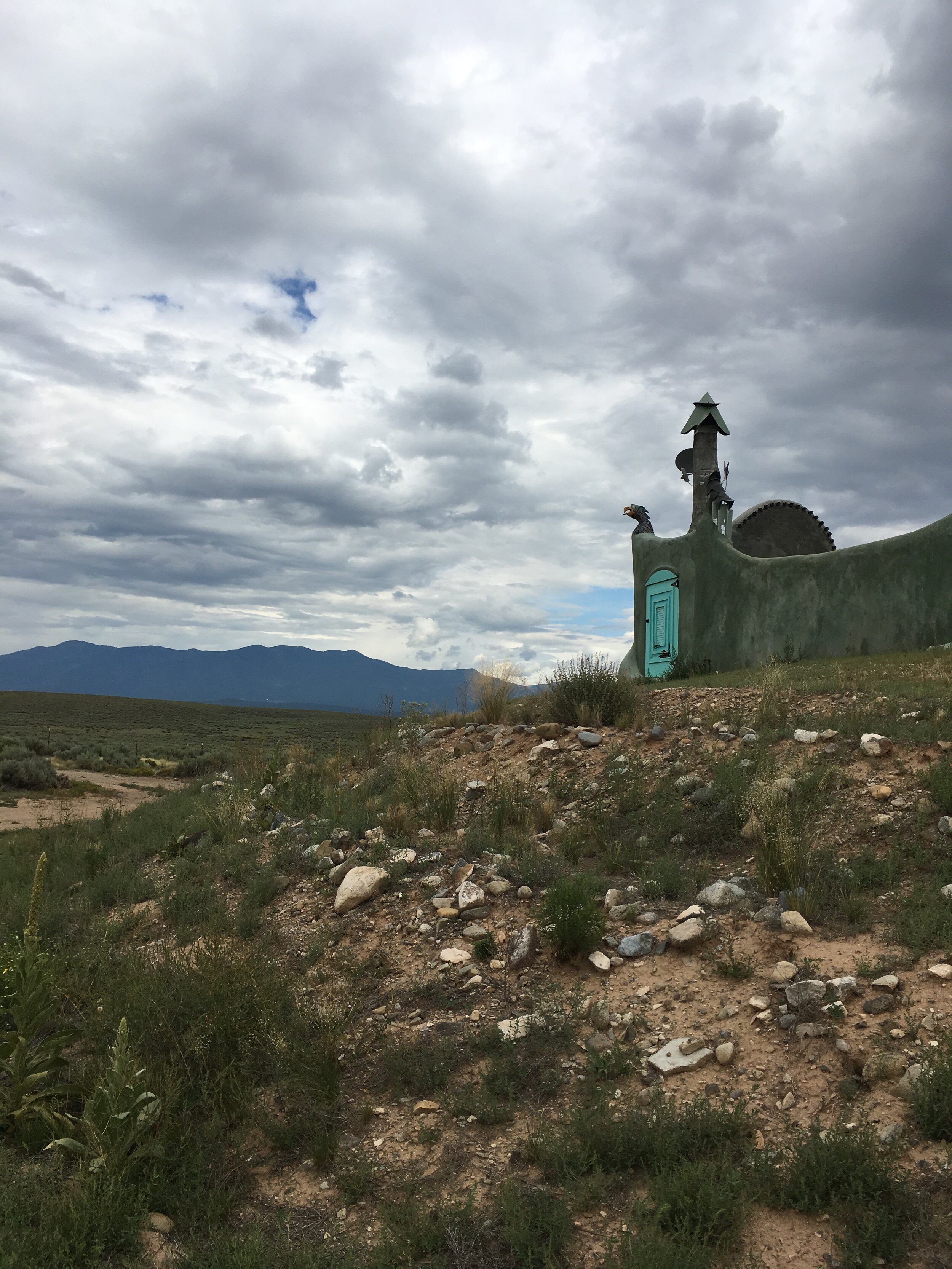
Perhaps the most magnificent feature of the Earthship’s architecture was thegreenhouse surrounding its exposed exterior. Tropical plants of all sorts—palm and fig and mandarin and banana trees, orchids, hanging vines—lined the walkway that stretched the distance of the interior garden. A second dining table was bookended by ponds, inhabited by koi fish and turtles. There were even cockatiels living in the greenhouse, flying freely as though it were an aviary. A second garden grew outside the greenhouse in an enclosed yard full of hardy desert plants, providing a home to a small group of egg-laying chickens. These plants and animals required constant care by Earthship Biotecture students and volunteers, and upon further research, it became clear to me that this kind of living home is not the sort of thing that most people could maintain. For all the effort and additional knowledge it requires, the reward is living in a house that sounds and smells and feels alive. The air is fresh and floral, combating the dryness of the desert. Stars are more visible through the ceilings of these Earthships than they are in most of the United States.I left the next morning sobered by the knowledge that “Phoenix” is on the market for $1,500,000—not exactly the price tag you would expect based on the intents presented by Earthship technology—tempered with the unshakable urge to follow the footsteps of my Earthship caretaker and attend the Earthship workshops and build my own. Earthships are not the revolution Reynolds touts them to be, but they are a most appealing repose from the coldness and alienation of the world by whichwe are so often surrounded.

Conversation with Photographer Mark Klett: Tomorrow (9/14), 7 PM, HRC

Tomorrow from 7 to 8 P.M. in the Harry Ransom Center, photographer Mark Klett and curator Jessica S. McDonald will discuss Klett's work photographing American landscapes since the 1970s."Since participating in the renowned "Rephotographic Survey Project" (1977–1979), Klett has investigated time, perception, and the history of photography in projects such as "Revealing Territory" (1982–2004), "Reconstructing the View" (2007–2010), and "Camino del Diablo" (2013–2015). Co-sponsored by the Department of American Studies."The Facebook page for the event can be found here: http://budurl.com/5chz
Summer Slow Down: Making All-Night Art with Mystery Spot Books
In this third installment of "What I Did on My Summer Vacation," UT AMS doctoral student Emily Roehl recounts her experience creating time-based, activist art in Minneapolis as part of the Northern Spark arts festival this past June.
In June, I traveled to Minneapolis to work with Chad Rutter, my Mystery Spot Books collaborator, on our first foray into time-based art. On June 10, we took part in Northern Spark, an all-night arts festival that popped up along the Green Line of the Light Rail between Minneapolis and St. Paul. For our project, The Slow Down, we commandeered a road construction sign and displayed a series of messages from participants, who were encouraged to consider practical ways to live with less of what the construction sign represents – a culture fueled by petrochemicals. On the night of the festival, we asked people why they might want to live with less oil. Their reasons were programmed into the construction sign and displayed on an ever-changing loop from sundown to sunrise.

Here are some of our favorite reasons collected during the night:
…because things should matter.
…because I like to see my city at the pace of a slow walk.
…because fear keeps us from considering new, more resilient possibilities.
…because I need a lot less than I think.
…because it's not all about comfort.
…because oil fuels conflict.
…because the world is changing and so are we.
…because *this* is our heaven.

Oil shapes our everyday lives. Cars are a large part of this, but so is our food system, the microfibers in our synthetic fabrics, and the personal products we apply to our bodies. From fast food to electronic devices to interstate highways, oil contributes to the speed of our lives. Rarely do we slow down and think through the everydayness of oil. By asking participants to slow down and extract a small part of their daily lives from oil, this project explored new ways of being at home in the world that do not rely on fossil fuels.

Our work for Northern Spark will find its way back into our primary medium: the artist’s book. Building on our recent series of publications called the Energy Landscapes of St. Louis, we will publish a book inspired by the reasons to live with less oil we collected at Northern Spark. This will be the first publication in our Energy Landscapes of the Twin Cities series.

"History, Labor, Life: The Prints of Jacob Lawrence": at Warfield Center's Christian -Green Gallery Until Dec. 9

The Warfield Center's Christian-Green Gallery is hosting an exhibition of one of the most influential 20th Century American artists, Jacob Lawrence. Best known for his Migration Series (1941) depicting African American life during the Great Migrations of the early- to mid-20th Century, Lawrence was the first African American artist to have his art included in the collection of the New York Museum of Modern Art.The Warfield Center's exhibition "provides a comprehensive overview of Lawrence's printmaking oeuvre, produced from 1963 to 2000." The exhibition is open to the public from noon to 5 P.M. Wednesday through Saturday and by appointment, at the Christian-Green Gallery located inside the Beauford H. Jester Center, 201 E. 21st Street.Full details for the exhibition can be found here: http://galleriesatut.org/event/history-labor-life-the-prints-of-jacob-lawrence/
LGBTQ Studies Program Inaugural Event: Justin Vivian Bond in Conversation
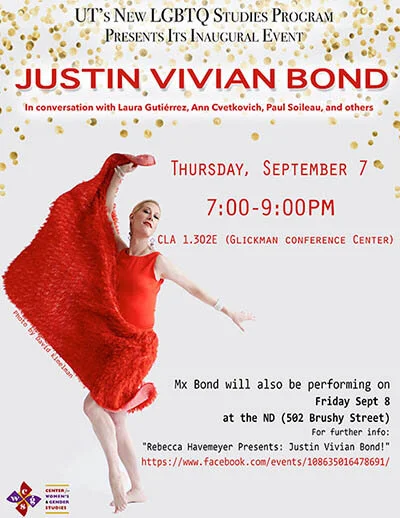
Tomorrow evening, faculty from UT-Austin's new LGBTQ Studies Program will be hosting their inaugural event: an evening with acclaimed performer, writer, visual artist, and recording artist Justin Vivian Bond. Mx Bond will be in conversation with UT faculty Laura Gutierrez, Ann Cveckovitch, and Paul Soileu in the Glickman Conference Center (CLA 1.302 E) from 7 - 9 P.M.From LGBTQ Studies: "Mx Justin Vivian Bond is a trans-genre artist living in New York City. As a performer both on and Off-Broadway, Mx Bond has received numerous accolades, winning an Obie (2001), a Bessie (2004), a Tony nomination (2007), the Ethyl Eichelberger Award (2007), The Peter Reed Foundaton Grant, and a New York Foundation for the Arts Grant for Artists. V authored the Lambda Literary Award winning memoir TANGO: My Childhood, Backwards and in High Heels (The Feminist Press, 2011).Films include John Cameron Mitchell's Shortbus (2006), Sunset Stories (2012), Imaginary Heroes (2004) and Fanci's Persuasion (1995). Solo exhibitions of JVB's watercolors, sculptural installations and live art have been presented by Participant, Inc. (NYC, 2011, 2016), Art Market Provincetown (2014), and Vitrine (London, 2015). Albums include Kiki and Herb: Do You Hear What We Hear?, Kiki and Herb Will Die For You at Carnegie Hall, Dendrophile, and Silver Wells. For further info: http://www.justinvivianbond.com/Mx Bond will also be performing on Friday Sept 8 at the ND (502 Brushy Street). For further info: "Rebecca Havemeyer Presents: Justin Vivian Bond!" https://www.facebook.com/events/108635016478691/ "Hope to see you there!
What I Did On My Summer Vacation: Gaila Sims

aarc.jpg

AARC Kids Yoga
After finishing my first year of graduate school, I was most looking forward to relaxing, swimming, and reading for fun. I was able to do all three of those activities this summer, but I actually spent the majority of the summer working at Austin’s Asian American Resource Center as an instructor for their summer camps. The Asian American Resource Center (AARC) opened in September 2013 and serves Austin’s Asian American and Pacific Islander communities with programming, resources, and community spaces. Among the center’s many educational offerings is summer camp, which usually runs June-August, and includes a number of themed camps meant to teach kids about Asian and Asian American cultural traditions.The first of this summer’s camps was “Game Master,” where kids learned coding basics and about traditional Asian games, including Yut Nori, Mah Jong, and Tuju Tins. We also made our own mancala sets and played a lot of ping pong. The second of the summer’s camps was “Art and Mindfulness,” during which campers were taught methods of mindfulness and meditation, all stemming from Asian and Asian American cultural practices. We learned about zen gardens, about sand mandalas, and did a lot of yoga. After “Art and Mindfulness” came “Tall Tales and Traditions,” which focused on storytelling, theatre, and oral history. This camp was especially interesting for me, since I had not previously known a lot about Asian storytelling traditions. We taught the kids about Kamishibai, a form of Japanese street theatre, as well as the Ramayana, an ancient Indian epic poem. The summer ended with “Asian Adoptee Camp,” which provided education and resources to adoptees, and allowed for community building among campers of various ages and from various cultural backgrounds. We talked about the history of Asian adoption in America, had great discussions about some of the challenges involved with being adoptees, and actually met adult Asian adoptees and got to learn about their experiences.I was one of three instructors for the camp, and spent most of my time with some of the younger campers, ages 5-8. The kids were wonderful, and had such unique perspectives, and it was awesome to be able to learn from my fellow instructors, both of whom have backgrounds in education. It was great to be able to spend time doing work totally different than what I do during the semester—teaching younger kids, learning about cultural traditions different from the ones I study, and working in a community center environment instead of on a university campus. While working at summer camps has its challenges, it was really nice to be able to spend time with kids and engage my brain in different ways. I’m grateful to have had the opportunity to do interesting and engaging work, and am looking forward to settling back into the semester, although I might see if some of my fellow graduate students are interested in playing some Mah Jong this semester, now that I finally know how to play.--Gaila Sims