Moments in Time: Eli Reed and Jamel Shabazz
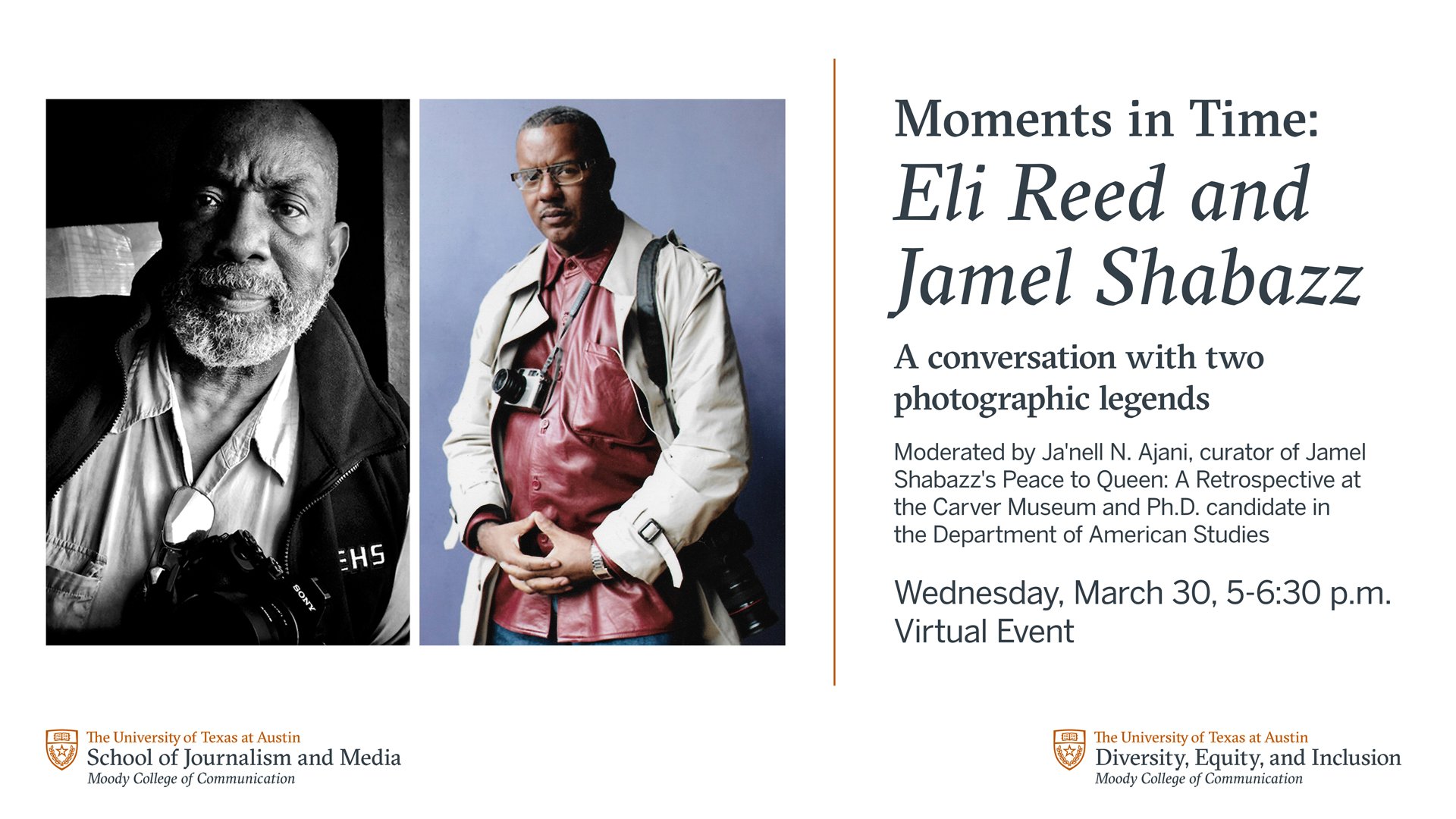
American Studies PhD student Ja’Nell N. Ajani will be moderating this conversation! Register here.
Experimental American Studies and the Elements of Marfa
photos + essay by randy lewis, chair and prof in the Department of American Studies, about one of the many exciting things going in UT American Studies: think of it as an invitation to create similar projects on other topics and in other places…
———————————————————————————————————————————————————
Do you ever think about the endless intricacies of the periodic table? You do? Well, not me!
Yet lately I’ve been wondering if humanities scholars have something worth saying about helium, nickel, copper, lithium and the rest of the elemental stuff we haven’t investigated since high school chem? Can we write something vivid and meaningful about the elements that emphasizes the power of culture, history, and identity in areas far from our usual expertise? My answer is firm and clear: definitely maybe!
At least that’s what I was half-seriously thinking when I joined a new collaborative writing project on the elements dreamed into existence by anthropologists Marina Peterson (UT Anthro) and Gretchen Bakke (Humboldt University, Berlin). In the past few months the dozen or so members of the project have each selected a single element to write about, with others expected to join in the months ahead. Then with initial funding from a Texas Global Faculty Seed Grant, we met in Marfa for two days of fieldwork, planning, and workshopping, with the ultimate goal of producing a short essay on every element in the periodic table. Imagine 118 tiny books on the cultural lives of the elements and you’ll get the idea.

On the sublime road from Marfa to Fort Davis, home of the McDonald Observatory (all photos by author)
Well known for their research on various kinds of infrastructure and atmosphere, Marina and Gretchen planned out a judicious blend of structure and chaos for the weekend (an overly structured event is deadening; pure chaos is disorienting). The long stretch of communal time allowed for something that’s rare on campus during the Zoom age: we got to know each other a little bit. Marina rented a small architectural gem of a house where we met up with a pile of books, electronic gear, basic bookmaking equipment, and posters of the periodic table. My first thought is wow: this is cool but what the heck are we doing?

Some of the books Dr. Marina Peterson had brought for our collective inspiration
And that’s not a bad question to ask yourself at the beginning of any research project. In fact, this positive perplexity is why my favorite work happens in situ and especially in places like Marfa. As a grad student in the early 1990s, my first trip to Marfa hit me like a meteor of possibility. Back then Austin was much more shaggy than cosmopolitan, very far from the slick global brand that it is today—so much so that Marfa seemed like Soho in the desert on one particular weekend in 1991 when I showed up in my little Ford pickup. Claes Oldenburg was strolling around the grounds of the Chinati Foundation, Gus Van Sant’s short films were projected inside an empty swimming pool, random bagpipers wailed like angry cats in the dark, and a smattering of local ranchers stood around a bonfire gripping Shiner Bocks and wondering what to make of all the wildly dressed art students. Everyone was mingling at a free annual party held by the minimalist sculptor Donald Judd, who had been remaking the town since relocating from Manhattan in the 1970s.
This wonderful weekend planted a seed in my mind that Marfa was a special place for creative experimentation, while also giving me hope for a kind of lone star transformation that often seems out of reach. Because my own family has been in the state since the 1830s, mostly not transforming, not finding an easier way forward (for instance, this is my wonderful but excessively hard-working aunt), I am incredibly invested in ways that Texas can change for the better—and watching my sleepy slacker Austin becoming a glitzy Technopolis with an Apple campus, million dollar condos, and a massive Tesla factory is not really what I had in mind.
My own aspirations are closer to what I found in Presidio county ever since that initial trip in 1991. If dusty little Marfa can go from a sleepy ranch town to a global art mecca (not without its drawbacks, to be sure), then perhaps our state can evolve into something other than heat-baked sprawl, CRT-phobic suburbs, struggling small towns, and an ever-widening interstate system that eventually swallows us whole.
Happily, the elements project has a perfect crew for imagining something better, if only in a preliminary and exploratory way. Some familiar faces are in the room in our little Marfa HQ-–Lindsey Freeman (Simon Fraser U) is one of the most perceptive and graceful writers now in academia. Craig Campbell was there in his old Mazda pickup with Queen Elizabeth waving ironically from the window: if you are doing something at the nexus of art and anthropology, or anything that is just plain novel, cool, and brilliant, Craig is probably in the mix (as he was for the Carceral Edgelands Project earlier this year, and the Ex Situ Collective, which has met for similar projects in Austin, Windsor, Athens, and here in Marfa in 2014 for which we had to create work while in transit). Fusing art and scholarship into a collaborative and often accelerated process is always a revelation, and these academic experimenters are my core peeps, intellectually and temperamentally speaking, as much as American Studies.

Dr. Craig Campbell, UT Anthro, with his regal co-pilot

Looking across Marfa’s main drag with some ironic commentary for academics who love to talk!
So what was the experience like? I rolled into town, dusty and tired in the late afternoon. Within 30 minutes, I wandered into the coolest shop ever, run by a wonderful guy who I interviewed for my film on Prada Marfa last fall, whose interior designer partner told me mind blowing stories about the contemporary art scene in Mexico City; then I walked into a photo shoot for a catalog where they let me sit inside a 1953 Studebaker Commander; and was told that Lady Gaga was in town for a Dom Perignon shoot (alas, untrue!), while a friend was emailing me that Grimes and Chelsea Manning are dating back in ATX. That’s how Marfa is. If I walked around a corner and bigfoot was playing banjo with Miranda July and Harvey Keitel with Beyoncé at the conductor's podium, I would have been like “sure… that makes sense.”

Marfa is heaven for people who love old trucks and cars (as the author does!). The elements (in another sense) weigh heavily on machines, houses, and people in West Texas.
For the next 48 hours I worked alongside various participants, watched a dirt devil rip off a big section of a roof, and prayed for the wind to die down because the swirling ragweed was hitting me like a thousand hangovers. At night we donned six layers of clothing and drove to the McDonald Observatory, which is one of the greatest appendages of the UT world. I peered through telescopes and saw Orion’s Belt, lunar close ups, and hazy nebulae, while the astronomers nerded out on our dopey questions. So many brilliant minds in the Davis mountains figuring out the universe—astronomers have to have the souls of poets, right? Perhaps the question for our gang is the obverse: do poets have the souls of astronomers?
An oblique form of inspiration bubbles up as we approach helium, hydrogen, lithium, and the rest of the cosmic stew in our own cult studies way, hoping to create micro books on individual elements. Mine is dedicated to lithium, about which I knew nothing last year. Now I is expert! (I’m riffing off an old engineering joke). For weeks I've been reading about its applications: the batteries of Elon Musk, the mental health of Brittney Spears, the music of Kurt Cobain. It’s in fireworks, pacemakers, lubricants, hydrogen bombs—everything seems to need it nowadays.
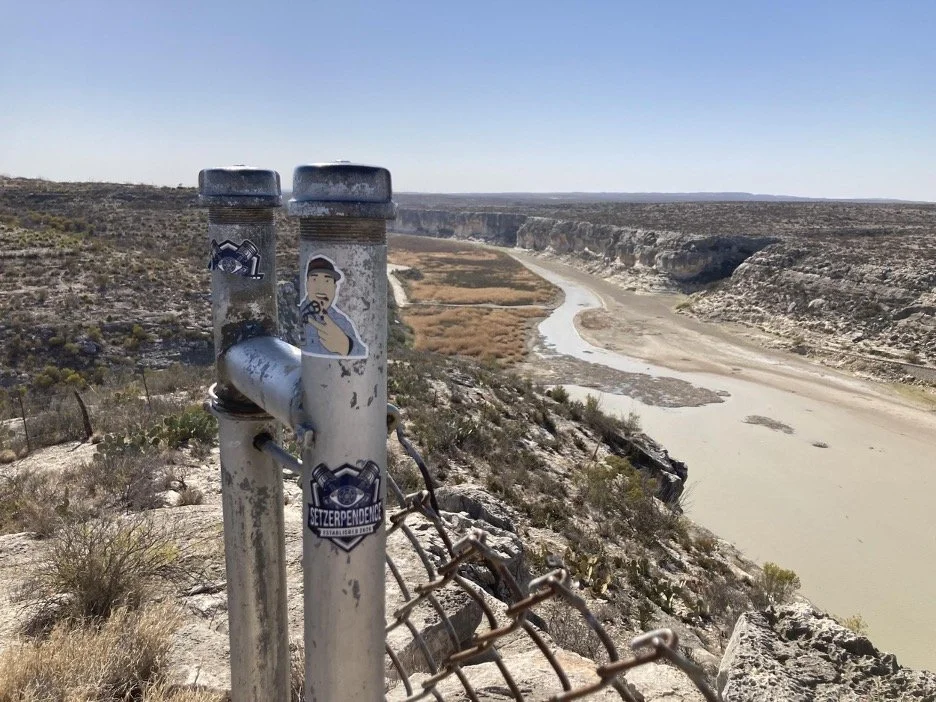
One surprise about driving from Marfa to ATX along the border is the extraordinary beauty of the Pecos Canyon Bridge, with hundreds of wild goats far in the distance. If we blew up the photo, you’d see them on the right side of the river.

The Elements crew took a field trip to Shafter, a nearby ghost town now where 2000 miners are buried. Almost no one lives there today, but we met a happy couple who had been residents for 30 years.
We kicked around another element in the morning, driving an hour south to take notes around a dead silver mine in Shafter, Texas, almost on the border. Megan Gette, a talented graduate student from anthropology with a creative writing background, used hydrophones and contact mics to record the ghostly sounds of metal and dirt. She let me listen to her headphones and I was shocked: a metal fence sounds like a didgeridoo when you tap it softly.
Group work is messy by necessity. Back in town we gently argue for an hour about what to call the publications. Over the course of two days we plan, write, design, cut and fold dozens of prototypes (one participant says it’s a bit like elementary school). It’s not all forward progress and it may not yield a consistent neoliberal knowledge-nugget with quantifiable “impact factor,” and yet I look around the room and see my favorite model of academic life. Anthropologists, humanists, sociologists, and poets. Lots of movement, lots of dialogue, lots of snacking. A lot of group work, DIY fashioning, and a handmade product that is about the creation of new forms of knowledge.
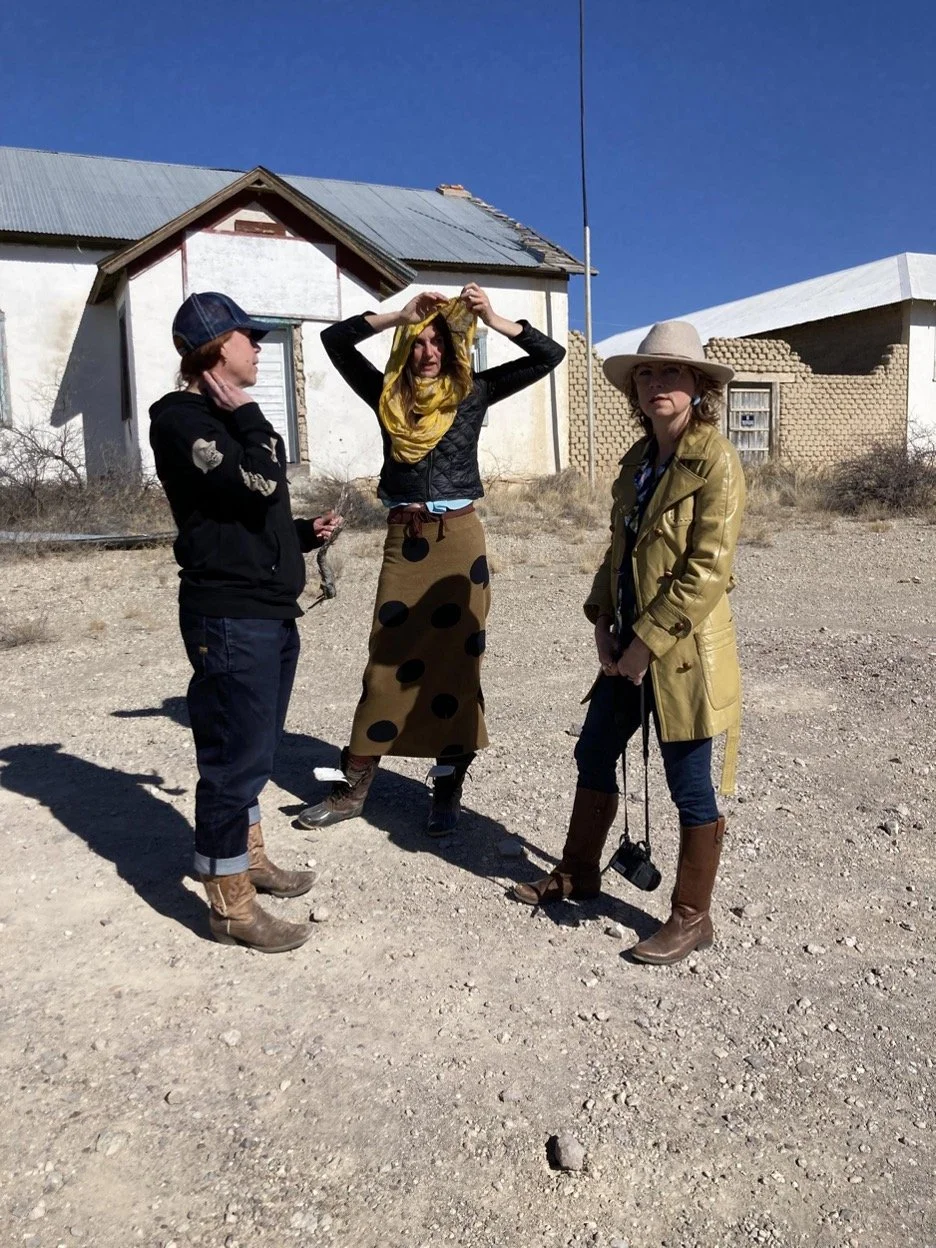
Co-organizer Gretchen Bakke from Berlin, along with Megan Gette and Monti Sigg from Austin
Not surprisingly, I start thinking of it as “artisanal academia.” Chaos and brilliance simmering on the stove together: it’s exhausting but convivial work that will yield an atypical academic “product.” Given the overproduction of standard journal articles that often go unread or quickly obsolete, I’m fascinated by our embrace of the ephemeral: we are in the realm of experimentation, collaboration, and innovation in form (which often happens when artists are injected into academic settings, or when you work with academics who are also artists/poets).

Pondering the elements!

The trailer park that never happened, near the ghost town of Shafter, which has an amazing local history center with fascinating information on display. Only a few people live nearby where once thousands lived and died in pursuit of silver (atomic number 47).

The reality of Marfa is a profound visual inconsistency in the built environment. It’s a rapidly gentrifying town where a NY investment banker might own a million dollar third home that they almost never visit—and it’s often right across from a house like the one above in the heart of town. Hyper-modern homes with lap pools and fragile leftovers are juxtaposed on Marfa’s streets, more so than anywhere I’ve ever been in the US. See Kathleen Shafer’s book on Marfa for more on the town’s history.
So that’s what I did for the first few days of Spring Break. People hear the word Marfa and they probably think minimalist art vacation or something—and it was in the sense of being out of the normal traffic and hustle of the violet crown.
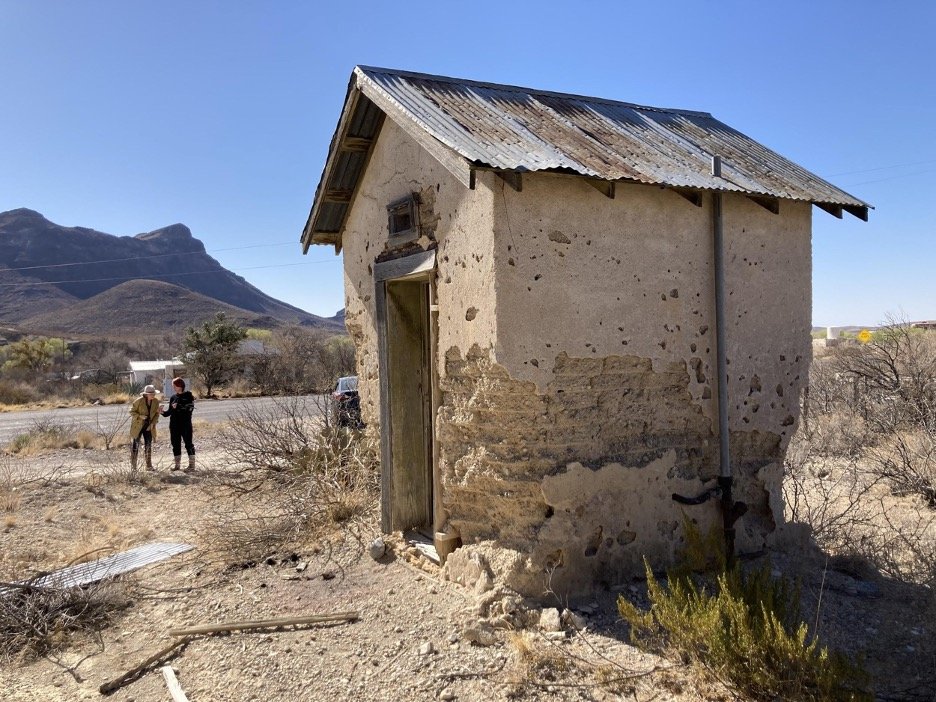
Near the abandoned silver mine of Shafter, searching for inspiration and/or a cell signal
But it’s also not nothing to drive 1000 miles in four days and take part in an ambitious collective experience, sustained mostly by the quality of the minds and the idealism of the people around you. I was exhausted when I rolled back into ATX, immediately sprinting to catch a bullet train of bureaucratic obligation. Squeezing back into my little work silo to manipulate symbols that flicker across multiple screens with endless continuity, simultaneously dulled and jittery, social but alone, I’m already thinking about the wildness and possibility in the elements of Marfa.

The great sociologist Lindsey Freeman, a Tennessean now in Vancouver, and the author of This Atom Bomb in Me and Longing for the Bomb

The author looking ready for the wind apocalypse in Shafter, with photographer Monti Sigg

The importance of snacks and wine to intellectual work can never be underestimated!

Traveling Back in Time to “Weird Austin:” Daniel Johnston “I Live My Broken Dreams
by Holly Genovese
Photos also by Holly Genovese

I’m not from Austin, or Texas, and before moving here in 2018 to study I had visited once, for 24 hours. I knew Austin had a reputation for being cool, but I couldn’t have told you why. I’m from the East Coast, and one thing I’ve realized since moving to Texas is that the East Coast thinks a lot of itself. We learn very little about anything west of the Mississippi and I only realized that when I left. I’m not from New York, not even close, but the “View of the World from 9th Avenue” cover of the New Yorker feels very relevant.

I didn’t know Austin used to be weird or that the city really loves movies or that so many famous people live here. I had no idea. I quickly realized that the “weird” identity of the city had all but disappeared decades before I arrived. Sure, there were the stickers. But it was difficult for me, moving to the city in 2018, to even understand what it was that Austin had lost. I knew it as a booming tech city, increasingly overpriced. I knew that it was incredibly white and getting whiter all the time. I knew that more and more tech moguls and celebrities were moving here. But much of the cool stuff had already been lost. I missed the last gasps of Austin as a hub for weirdos and creatives and moved here when it was already really hard to survive as a weirdo or creative (or a student, like me). To me, Houston, with its food scene and museums and Parts Unknown episode seemed like a real weird, creative city.
Even though I got here too late, there were still closures that hurt. The loss of our two video stores, Vulcan Video and I Luv Video, hit me hard. And the pandemic closure of Spiderhouse Cafe, which I didn’t learn about for months. And I’ve slowly discovered the places that do make Austin special–AFS, for one. Austin City Limits. The many independent bookstores, including Bookwoman, which has been around for 40ish years. But what really showed me what Austin once was, and never could be again, was the Daniel Johnston exhibition at The Contemporary ATX. The exhibit focuses on Johnston’s legacy–both his connection to Austin as well as his artwork and music. Johnston was the quintessential Austin weirdo-handing out mixtapes with hand drawn art at the Mcdonalds on Campus (there was a McDonalds on campus?). He gave off tremendously low-fi vibes in the early 90s, even as he painted a famous mural and Kurt Cobain wore a shirt with his artwork on it.
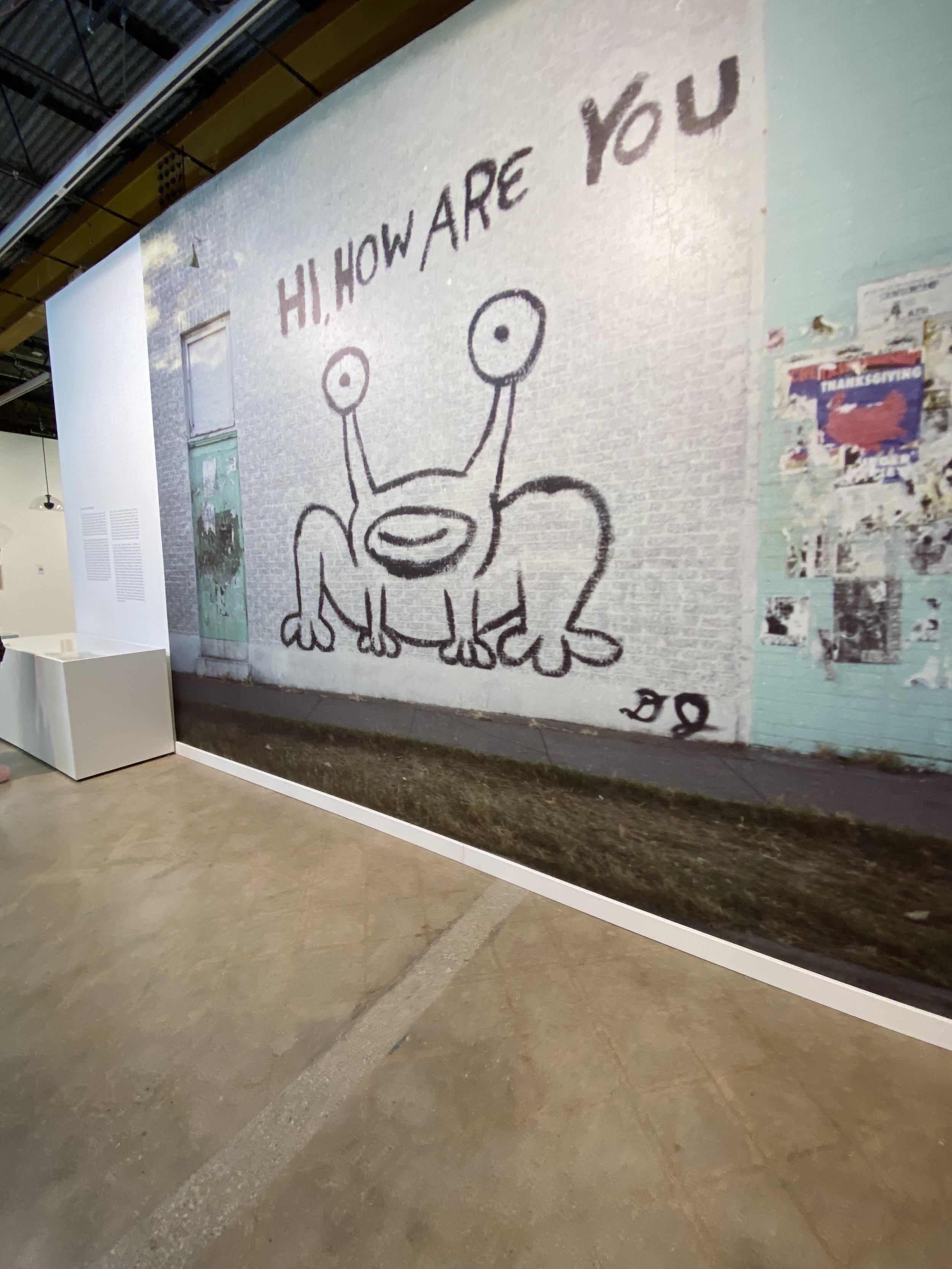
The exhibition shows the evolution of his work, as well as his music, and even includes a recreation of his workspace. A piano surrounded by toys and comics and funky objects. His work asked big philosophical questions through comic inspired art (Johnston loved Marvel).

I don’t why, but seeing Johnston’s art, seeing what Johnston was able to create in Austin, finally showed me what was lost when Austin stopped being weird. The Sound Exchange, where Johnston painted his famous mural, has been closed for 20 years. Nearly a decade before that, it was voted the “Best Place to Buy into the Underground” by the Austin Chronicle. For many new Austinites, the Underground has never existed in Austin. But the Contemporary’s exhibit on Johnston gave me a way of seeing an Austin that, for me, would never exist.

You have four more days to see “Daniel Johnston: I Live My Broken Dreams” and it’s absolutely worth braving the SXSW crowds for the chance to travel back in time to cool, weird, Austin.
Contemporary Art in San Antonio 2022-A quick look from UT Am Studies
“As an American Studies department based in Austin, we are lucky to have San Antonio just an hour away. On my way back from a two day writing workshop in West Texas with 15 scholars from all over, and after pausing at Judge Roy Bean’s homestead in Langtry, I stopped to see contemporary art shows at the city’s main museum as well as the small but always interesting ARTPACE. The shows were so good that I thought I’d make a 4 minute video that would serve as a introduction to our students and anyone else who is curious. If you haven’t been to these places, or if you don’t know Wendy Red Star, now is a great time to head down I-35.” — Randy Lewis, Chair, Dept of American Studies
Third Thursday Weds March 23rd

Come learn about the Annual Sequels Conference as well as the E3W Review of Books, which many UT AMS students have worked on!
UT AMS Alum Dr Christine Capetola to Give Talk Today

Contact Dr. Capetola for access information,

Professor Janet Davis featured on “I Don’t Know About That”Podcast

AMS professor Janet Davis was recently featured on “I Don’t Know About That,” a podcast hosted by Jim Jefferies. For more on the podcast writ large, click here. To listen to Professor Davis’s episode on the circus specifically, you find it here!
Five Questions with First- (and Second-) Years: Amanda Tovar
We’re excited to kick off another year of our “Five Questions” series. This year, we’ll be featuring both first- and second-year students here at UT AMS. We look forward to sharing our amazing graduate students with you. Read on to learn more about Amanda!
Q: What is your background, academic or otherwise, and how does it motivate your research?
A: My academic background is in Mexican American & Gender Studies. Truthfully being a Xicana is what informs my academic career. Gloria Anzaldúa writes “I am trying to make peace between what has happened to me, what the world is and what it should be” and I truly feel that nothing is more useful in my life than understanding myself in relation to the rest of the world—that alone motivates me to unpack the historical nuances of the Rio Grande Valley to better understand my lived experiences which is the bulk of my research.
Q: Why did you decide to come to AMS at UT for your graduate work?
A: While researching PhD programs I paid specific attention to programs who seemed proud of their students as well as diverse and interdisciplinary dissertations. Aside from that location was a huge factor. I applied to ten programs throughout the country and got into 5—but I wanted to stay as close to the Rio Grande Valley (and the Texas heat) as possible. UT AMS fit the ENTIRE profile!
Q: What projects or people have inspired your work?
A: This might sound completely self-absorbed, but my life experience is what has largely influenced my work. The second I mustered up the courage to tell my experience regarding sexual assault, many of my friends and family shared their experiences with me. I began to view sexual assault as endemic to my community and I wanted to expose the crux of it to first understand but also to find a way to combat it.
Q: What projects do you see yourself working on at UT?
A: To be honest, I don’t know what I am going to do tomorrow so I cannot earnestly answer what I see myself doing here project-wise. HOWEVER, I have many ideas. I recently started to let loose and explore my other interests academically—like Sci-Fi movies! But my time in AMS inspired me to launch Escuelín which is a social media platform to emphasize knowledge that my community already holds outside of academia and traditional K-12 schooling.
Q: What are your goals for graduate school? What do you see yourself doing after you graduate?
A: My goals for graduate school are first and foremost to get through it! Just kidding! My after-graduation goals are to either be a professor in my hometown or to own a bookshop/coffee shop. I have always envisioned myself making artisanal sandwiches and selling revolutionary books while hosting a free Saturday school.
Bonus Q: In your own words, what is American Studies?
A: To me, American Studies is my home. It’s where I can study all of my interests at once—from critical race theory, to sexual violence, to the Borderlands and beyond.

Meet Amanda Tovar, a second-year doctoral student in the UT American Studies department.

AMS Undergraduates: Chase C. Seabourn
This week, we’re highlighting the American Studies Department’s fabulous undergraduates — both those currently enrolled and recently graduated. Our final feature is of Chase C. Seabourn, who was awarded the University-Wide Endowed Presidential Scholarship for the 2021-2022 academic year.
Q: Why did you decide to major in American Studies?
A: I chose American Studies because this field presented me with the perfect culmination of my interests - Sociology, History, and Culture, to name only a few. I took Intro to American Studies because I had a close friend who was an American Studies major, and I instantly fell in love with the nuance and relevance. American Studies feels like the world spoken in a language of unbridled truth and urgency. I feel as if I am learning about the world in a way that finally makes sense to me—not as just a core subject—but as an exploration into the many facets of human existence in this country.
Q: What are your other majors and how do you see these interests intersecting with American Studies?
A: Initially, I studied Biology and added American Studies as a double major. I am, however, dropping my Biology major simply because I do not need it and do not desire to finish its coursework. I am Pre-Health, and American Studies is the perfect fit for how I approach healthcare. Interrogating the subcultures that influence each and every American differently helps me understand the people I meet on a deeper level. Public health requires empathy and understanding; it requires professionals who are modern people and 3-dimensional.
Q: What have been some of your favorite courses in the American Studies department and why?
A: It’s so hard to pick a favorite course because I’ve genuinely loved every course I’ve taken in this department, but I have to say my three favorites were Preserving Queer History in ATX with Dr. Gutterman, Diners, Drive-ins, and Dives with Dr. Knerr, and Black Political Thought with Dr. Marshall. Dr. Gutterman’s course took me outside of academia and gave me the invaluable experience of oral history with my queer community, an experience I’ll treasure forever. Dr. Knerr’s course helped me analyze social spaces and food cultures in a way that I had never done before. It further opened my eyes to how rich the world is in social tradition. Lastly, Dr. Marshall’s course provided me with such an in-depth learning experience of Black history from probably the most intelligent and well-spoken man I’ve ever had the privilege of meeting. I’ve never been so enamored by and thankful for readings in my life.
Q: What are some of the most important questions you’ve considered and research you've undertaken during your time in American Studies?
A: The two greatest research questions I encountered were independent, and I’m not quite sure I would’ve had the opportunity anywhere else. In Prison Art, Literature, and Protest with Prof. Genovese, I wrote a research paper over necropolitics - the phenomenon of those in power ultimately choosing who is worthy of life and who is worthy of death via the quintessential example of the American prison. Necropolitics have been a potential research point for me for a long time, and I am very grateful to have had the forum to research such a meaningful subject. The other standout research I did was in Dr. Gutterman’s course where I did an oral history interview with Dr. Yolanda Chávez Leyva. I was able to get her meaning of the intersection between queer and Latinx liberation. She is an incredible woman, and it was an invaluably enriching opportunity.
Q: How has your time in American Studies influenced your career goals? How do you think American Studies might influence your next steps after graduation?
A: My time in American Studies has forced me to stare intensely at my future career. Right now, I intend to pursue Psychiatry, a practice that involves patience and letting people guide me to where they’re at in life instead of speaking over them. American Studies introduced me to a bank of knowledge and experiences that will help me practice healthcare in the most ethical and moral way I know how; it sets a standard. Despite this, this department has also inspired me to explore new options for myself like activism through civil law or even becoming a historian. There’s not one avenue I can take where my passion for American Studies won’t be incredibly useful and inspiring. I have loved every second of my time here.